Leading an AI Transformation: Why People Matter More Than Ever
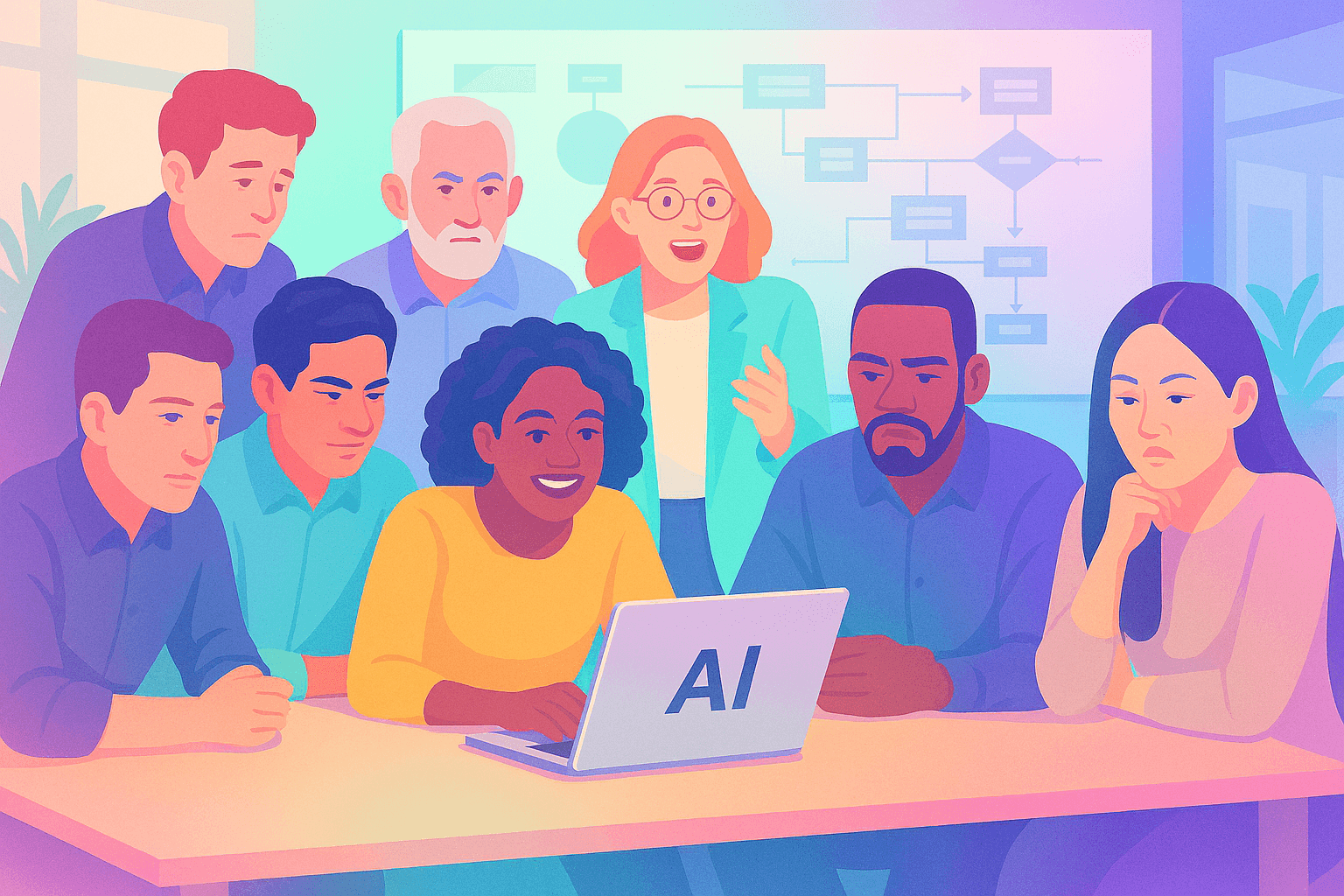


Artificial intelligence is transforming the way organisations work, innovate, and compete. The excitement is real as AI tools promise greater efficiency, creativity, and entirely new ways to solve problems. But amidst the hype, it’s crucial to remember a timeless truth: technology doesn’t change organisations, people do. The system doesn’t change unless the mindset of the people who operate the system changes. Without thoughtful, human-centred change management, even the most advanced AI initiatives will stall. This article explains how leaders can navigate the emotional, cultural, and behavioral realities that determine whether AI transformation succeeds. AI is moving at the speed of light, but organisations can only move as fast as their people are willing to change.
Understanding Change Management in the Age of AI
When discussing change management, good old John P. Kotter, change management guru with an eight-stage process, remains a valid reference, even though traditional change cycles are too slow for today’s pace. In the AI transition, it shouldn’t be hard work “Establishing a sense of urgency” as laggards adopting AI have a real threat to fall behind competitors economically, lag in innovation and creativity, and miss the shift in value creation.
Urgency alone is not enough; it’s only the first step. Organisations must articulate a clear strategic vision for why AI matters and what value it should bring. Employees need to understand where the company is heading, what problems AI will solve, and what will be expected from them in the future. As important as solving the problems with AI, is to emphasise processes and ways of working which are already functioning.
Transparent communication is essential. Transparency doesn’t mean having all the answers; it means being honest about what is known, what is still uncertain, and how decisions will be made. People sense when something is kept and fill the gaps themselves, causing unnecessary corridor talk and resistance. Sugarcoating, exaggerated promises, or overly positive spin should be avoided, especially where the future may involve role changes, skill shifts, or uncertainty. Patronising communication erodes trust. Authentic communication strengthens it.
How Culture Shapes AI Adoption
Culture plays a powerful role in how individuals and organisations respond to new technologies. Norms, values, and shared assumptions shape how people evaluate risk, approach novelty, and tolerate ambiguity. Cultures or teams characterised by adaptability, collaboration, continuous learning, and risk tolerance typically embrace AI with more enthusiasm and speed. Meanwhile, groups that value stability, predictability, careful planning and traditional structures may require more support and time.
Factors such as age, personal values, and digital nativeness shape how individuals interpret the shift. A digitally native employee may see AI as a natural extension of their workflow, while someone with decades of experience may view it as an existential threat or a challenge to their competence. Culture determines whether AI feels like a threat or an opportunity. Leaders must understand these cultural dynamics and create environments where diverse reactions are acknowledged rather than judged.
Change Resistance: A Human Response to an Unpredictable Future
Much of today’s AI conversation centres on efficiency, automation, and the reshaping of work. Naturally, this introduces fear and resistance as humans often prefer stability. Attitude towards change is more positive if one is in the driver’s seat; people don’t want to be handled. Being a target for change can evoke emotions such as fear of losing control and insecurity. When stressed, threads and risk scenarios are overrepresented in one’s mind. There is also a great difference in how individuals tolerate uncertainty, where past experiences and what else is ongoing in life have an impact.
AI technology keeps moving forward faster than the ink dries on the instructions we just wrote. It will raise valid concerns if I can keep up with the pace of change and adapt to new tools. Does it mean that work changes the way that I can’t handle it anymore, or does my role not include meaningful content? Will the role even remain, and can I keep my job? Real-world examples amplify these concerns. AI tools can already perform tasks, generate code, and simulate roles. (Listen for example Lenny Rachitsky’s podcast where he interviews Product Manager Zevi Arnovitz)
Fear and anxiety, these normal feelings, can show up as change resistance and anger. It’s a protective mechanism from being vulnerable and being only a target without a voice. Resistance also tells us that people care and are ready to push back. Good change management validates these emotions rather than dismisses them.
We should also understand that the need for change is not necessarily equally evident across all layers of an organisation, where leadership has a more strategic view. While leadership may have already processed the strategic rationale and reconciled their own questions, employees are only beginning their journey, hearing about the change for the first time. Recognising this gap helps leaders communicate more effectively and with greater patience throughout the entire change process.
Even though most focus is typically on people being resistant, we should not forget those who are change-positive. They may also struggle with the load on memory, distractions from routines, and learning new things. The third group to pay attention to is the quiet nod. They may pretend to be on board, but eventually change nothing about how they work. For many in this quiet group, participation tends to grow when the change feels personally meaningful and when they can see small, early signs of its value.
Trust Is the Foundation of Every Transformation
When leaders communicate openly, act consistently, and show genuine empathy, they foster safe environment for people who navigate uncertainty.
Leading the change is not an easy job. Leadership doesn’t start with change management; it starts long before that - with trust. People are more likely to follow leaders they believe in, not just strategies printed on a slide deck. In AI transformation, trust becomes even more essential because technology often triggers fear of becoming obsolete. Trusted leadership reduces fear and fuels engagement, welcoming all reactions. When leaders communicate openly, act consistently, and show genuine empathy, they foster a safe environment for people who navigate uncertainty. Good leaders see beyond behaviour and make people feel included, heard and supported simply by saying “I understand this may feel difficult”.
Leaders must also model curiosity and continuous learning to demonstrate that adapting new ways of working is a shared journey, something we embrace together. AI transformation is not simply technical; it is deeply human. Leaders who show vulnerability, ask questions, and learn alongside their teams set the tone for healthy adaptation.
Driving AI Transformation with a Dual Strategy
Successful AI transformation depends on more than deploying new technologies, as it requires a deliberate approach to guiding people through change. Good practice to lead the transition typically relies on a dual strategy: reducing resistance while simultaneously accelerating positive momentum.
Reduce friction
As people often react to major shifts with hesitation, leaders must acknowledge these responses rather than ignore them. This means communicating transparently about the purpose and impact of the transformation, creating opportunities for open dialogue repeatedly, and offering training and support that help employees build confidence.
It also includes giving people space to process the emotional side of change, clarifying what aspects of their work will evolve and which will remain familiar, and involving them in shaping new workflows. Collaboration and asking for input can’t be highlighted enough. When individuals feel a sense of agency instead of being passive recipients, they adapt more readily and with greater commitment.
Amplify momentum
Active change management is not only about removing obstacles. At the same time, effective AI transformation requires enhancing and accelerating the aspects of change that are already working well. Leaders play a crucial role by celebrating early successes, highlighting meaningful wins that demonstrate progress, and empowering early adopters who can influence their peers.
As momentum builds, it becomes equally important to stay attentive to emerging challenges and remain flexible enough to adjust to the course when needed. Transformations, especially fast-developing AI initiatives, rarely follow a predictable or linear path. Instead, they often involve periods of uncertainty, rapid shifts, and unexpected obstacles and opportunities. Navigating this landscape calls for curiosity, agility, and continuous real-time adaptation, with a willingness to explore without knowing all the details.
When organisations combine these two elements, reducing friction on one side and amplifying momentum on the other, they move beyond simple adoption. They create the conditions for genuine commitment, ensuring that AI becomes not just a new tool but a foundation for long-term transformation and growth.
Conclusion: AI Is a Technological Shift, but a Human Journey
AI transformation is one of the most important organisational changes of our time. But despite its technical nature, success depends overwhelmingly on human factors: culture, trust, emotions, and leadership. Those who ignore the human side of things are at risk of failing.
Organisations where leaders actively support the change, communication is open, employees are actively engaged, and leaders help employees to see how change shapes the future are more likely to succeed in AI adaptation and make it a real strategic advantage. AI may accelerate the work, but people will always accelerate the change.
Share on:


Want to read more about Rebase? Check out our other stories


Mastering Authentication Flow
"Tired of frequent logouts disrupting your app experience?"
Mastering Authentication Flow
"Tired of frequent logouts disrupting your app experience?"